Figuring Out Your Nevada Home Sale Proceeds and Taxes
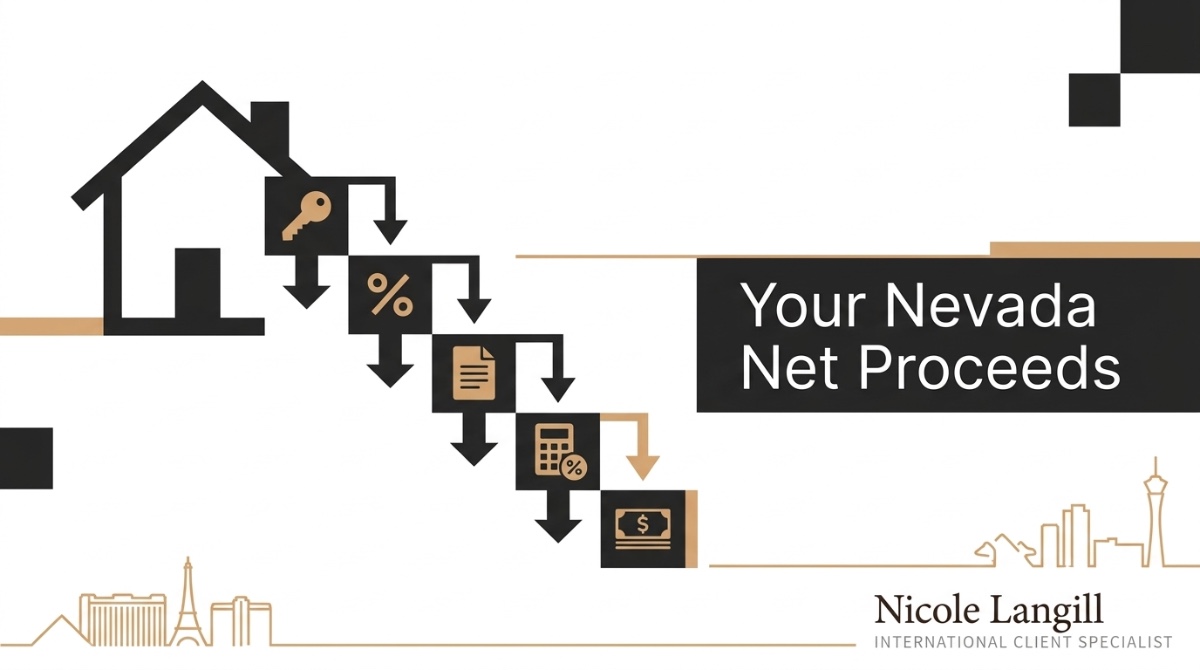
You want to know exactly what you get to keep when you sell your house. Figuring out your Nevada home sale proceeds involves taking the final sale price and subtracting commissions, closing costs, your current mortgage payoff, and any taxes. I am going to walk you through each of these deductions step by step so you know what check to expect at closing.
Table of Contents
Here is a quick look at the steps we will cover. You can jump directly to any section to find the exact details you need.
- How to Calculate Nevada Home Sale Proceeds
- Starting with the Sale Price
- Subtracting Real Estate Commissions
- Factoring in Clark County Closing Costs
- Paying Off Your Existing Mortgage
- Understanding the Capital Gains Exclusion
- The Two-in-Five-Year Rule for Taxes
- What Happens if You Do Not Meet the Two-Year Rule
- Figuring Out Your Adjusted Basis
- FAQ About Nevada Home Sale Proceeds
How to Calculate Nevada Home Sale Proceeds
When you sit down to plan your next move, you need an accurate picture of your net profit. Your Nevada home sale proceeds are the actual dollars transferred to your bank account after all the required fees and debts are settled. Calculating this number early helps you know your true budget for your next house. You can estimate your bottom line by taking your expected price and working down the list of standard deductions. If you are wondering about current market values first, you can read my thoughts on whether your Las Vegas Valley house is worth more or less than last year.
Starting with the Sale Price
The calculation always starts with the gross price your buyer agrees to pay on the contract. This number is not what you walk away with, but it sets the baseline for the fees that follow. The final price you secure depends heavily on your initial list price strategy. If you price too high out of the gate, you might end up accepting a lower offer later. You can learn more about the true cost of overpricing your Las Vegas Valley home.
Setting the right price means looking at recent sales in your immediate neighborhood. I look at the condition of your home compared to those closed sales to find a realistic baseline. Buyers today have plenty of options, so an accurate initial price is the best way to secure a strong offer. Once we have a firm contract price, we can start subtracting the costs to sell.
Subtracting Real Estate Commissions
Real estate commissions are typically the largest single expense you will deduct from your sale price. These fees compensate the brokerages that handle the listing, marketing, and the buyer’s side of the transaction. The total commission is a percentage of the gross sale price, negotiated before you sign a listing agreement. The fees are split between your listing agent’s brokerage and the buyer’s agent’s brokerage at the close of escrow.
You do not pay these fees upfront out of your pocket. The title company deducts the agreed-upon percentage directly from your sale funds on closing day. This structure ensures all professional representation is covered by the equity in your home. Knowing this percentage in advance makes it easy to subtract it from your expected contract price.
Factoring in Clark County Closing Costs
Beyond commissions, you will pay a set of closing costs to process the transfer of your property. The most significant of these is the real property transfer tax. In Clark County, this tax is strictly set at five dollars and ten cents per one thousand dollars of value. For a five hundred thousand dollar sale, that equals two thousand five hundred and fifty dollars deducted from your side.
Other standard closing costs include title insurance, escrow fees, and sometimes a home warranty for the buyer. Escrow fees are usually split equally between you and the person buying the home. Title insurance protects the new owner and is typically paid by the seller in our local market. All of these items will be listed clearly on your settlement statement before you sign the final papers. For a deeper dive into the selling process, check out what to know about selling a Las Vegas home this year.
Paying Off Your Existing Mortgage
If you still owe money on your house, that debt is paid off directly from your sale funds. The escrow company will request an official payoff demand from your lender. This document shows exactly what you owe, including the principal balance and any daily interest accrued up to the day of closing. It is important to know that your payoff amount will be slightly higher than the balance shown on your last monthly statement.
Any second mortgages, home equity lines of credit, or tax liens will also be settled at this time. The title company makes sure these debts are cleared so the new owner receives a clean title. Once the primary mortgage and any other property debts are subtracted, the remaining money is your gross cash profit. This is the amount you actually receive, but you still need to consider federal taxes.
Understanding the Capital Gains Exclusion
Once the money hits your account, the federal government may want a piece of your profit. You can often shield a large portion of your money from taxes by using the primary residence capital gains exclusion. This tax rule allows single filers to exclude up to two hundred and fifty thousand dollars of profit from their taxable income. Married couples filing jointly can exclude up to five hundred thousand dollars.
This exclusion only applies to the profit you made on the sale, not the total cash you received. It is a powerful tool to keep your hard-earned equity in your own pocket. To qualify for this benefit, you need to pass a specific test regarding how long you owned and lived in the house. You do not need to buy another property to claim this exclusion, as you can use the cash for anything you want.
The Two-in-Five-Year Rule for Taxes
To claim the capital gains tax exclusion, you must pass the ownership and use tests set by the Internal Revenue Service. The rule states you must have owned the home for at least two of the five years immediately preceding the sale. You must also have lived in the house as your primary residence for at least two of those same five years. The two years of use do not have to be consecutive blocks of time.
If you rented the home out for a year, moved back in, and then sold it, you can still qualify as long as your total living time adds up to twenty-four months. People who split their time between multiple states need to prove the Nevada house was their main home for the required duration. If you meet both the ownership and use tests, you can apply the full exclusion to your profit. I always recommend showing your timeline to a tax professional to confirm your eligibility before you list.
What Happens if You Do Not Meet the Two-Year Rule
Sometimes life events force you to sell your house before you hit the two-year mark. If you have to move due to a sudden job transfer, serious health issues, or an unforeseen event, you might still get some tax relief. The federal rules allow for a partial exclusion in these specific hardship scenarios. The amount you can exclude is prorated based on the number of months you actually lived in the home.
For instance, if you lived in the house for twelve months before a mandatory job relocation, you might qualify for fifty percent of the standard exclusion. That means a single filer could still exclude up to one hundred and twenty-five thousand dollars of profit. You will need to provide documentation of the hardship if you are audited. A licensed accountant can tell you exactly which life events qualify for this partial benefit.
Figuring Out Your Adjusted Basis
Your taxable profit is not just your sale price minus your original purchase price. You calculate your actual gain by comparing your net proceeds to your adjusted basis. Your adjusted basis is the amount you originally paid for the house, plus the cost of any major improvements you made over the years. A new roof, a kitchen remodel, or adding a pool will increase your basis and lower your taxable profit.
Routine maintenance and simple repair bills do not count toward your adjusted basis. You should keep all your receipts for significant upgrades in a safe file while you own the house. When it is time to sell, you will add those improvement costs to your original purchase price. You subtract that total adjusted basis from your net proceeds to find your final taxable capital gain.
FAQ About Nevada Home Sale Proceeds
Do I have to buy another home to avoid capital gains tax?
No, you do not have to buy another home to claim the capital gains exclusion. The old rule requiring you to roll your money into a new house was eliminated decades ago. As long as you meet the two-year ownership and use tests, you can take the cash and do whatever you like with it.
Who pays the real property transfer tax in Nevada?
Legally, both the buyer and seller are liable for the real property transfer tax. However, the standard practice in Las Vegas is for the seller to pay this tax at closing. It is a predictable fee, and your escrow officer will calculate it exactly based on your final sale price.
Are there state capital gains taxes in Nevada?
Nevada does not have a state income tax, which means there is no state-level capital gains tax on your home sale. You only need to worry about the federal capital gains tax rules. This is a major benefit for people selling real estate in the Las Vegas Valley.
How do I get my money after closing?
Once the deed is recorded with the county, the escrow company will disburse your funds. You can choose to receive a physical check or have the money wired directly into your bank account. A wire transfer is the most common and secure method, and the funds usually arrive within one business day of recording.
I am here to help you get the best possible return on your house. Call or text me when you are ready to look at your expected numbers and list your home.