The Las Vegas housing market doesn’t move the way most people think it does, especially when it comes to your initial listing strategy.
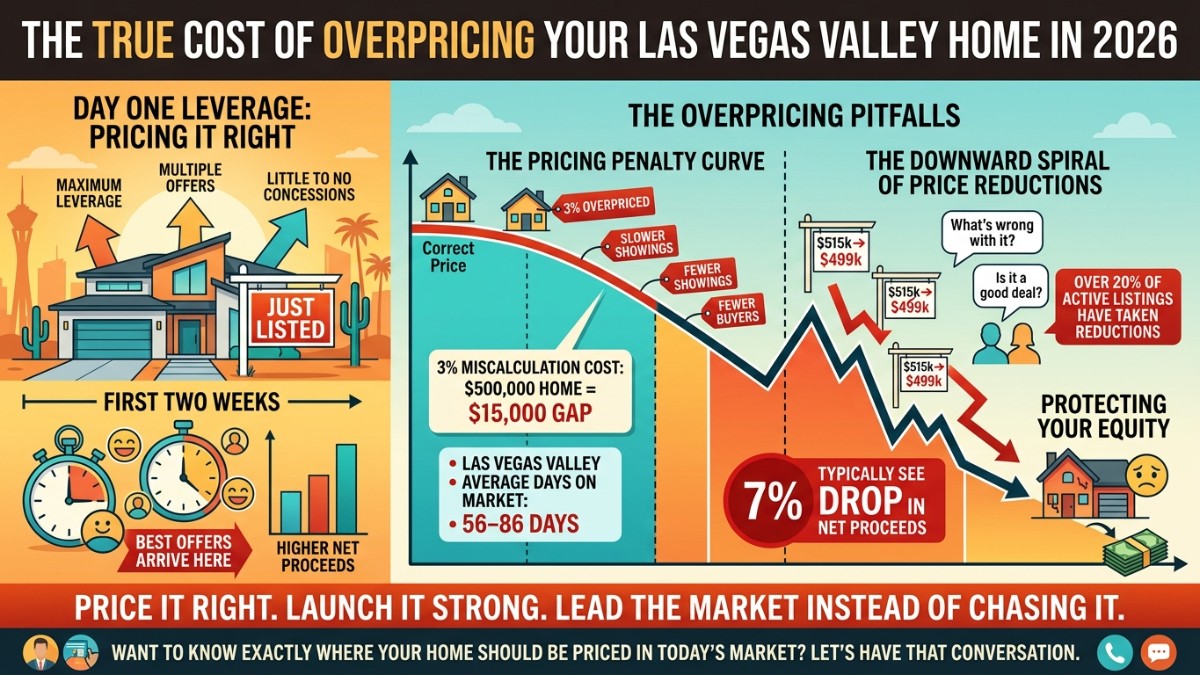
There’s a concept in real estate called the pricing penalty curve. It dictates exactly how much equity you walk away with at closing. And if you’re thinking about selling in the Las Vegas Valley, understanding this before you list is the single most important move you can make.
The Power of Day One Leverage
Pricing your home correctly from the start creates maximum leverage. Full stop.
When your number aligns with current market data, you’re likely to see strong buyer competition, multiple offers, and little to no seller concessions. That momentum translates directly into maximum net proceeds. And the data is consistent on this: the best offers arrive in the first two weeks of a listing going live. Not month two. Week one and two.
Miss that window, and the math starts working against you.
What a 3% Miscalculation Actually Costs
Overpricing by just 3% feels like a safe negotiating buffer. It isn’t.
On a $500,000 home, that’s a $15,000 gap. On a $1,000,000 property, it doubles to $30,000. Buyers notice the discrepancy immediately. Showings slow down. The home sits. And in today’s Las Vegas Valley market, the average days on market is already running 56 to 86 days, depending on price range and location.
That stagnation doesn’t just cost time. It costs leverage.
The Downward Spiral of Price Reductions
When a home sits, price reductions follow. Currently, over 20% of active listings in the Las Vegas Valley have already taken at least one reduction — and the moment your listing joins that group, the conversation shifts.
Buyers stop asking what makes the home special. They start asking what’s wrong with it.
That question is expensive. Precise day one pricing has never been more critical than it is right now.
Protecting Your Equity
By the time an overpriced home finally sells, sellers typically see a 7% drop in net proceeds.
That loss doesn’t come from market conditions. It comes from the pricing decision made before the sign was placed in the yard.
Price it right. Launch it strong. Lead the market instead of chasing it.
Every seller’s situation is different, and your pricing strategy should be built on data specific to your neighborhood, your property, and today’s buyer pool, not on a number that feels comfortable.
If you want to know exactly where your home should be priced in today’s Las Vegas Valley market, let’s have that conversation.