Real estate decisions in a fast-moving market require more than just enthusiasm; they demand a clear-eyed look at the numbers. Buyers often spend months analyzing purchase prices and mortgage rates, yet they sometimes overlook the final financial hurdle at the settlement table. Understanding your Nevada buyer closing costs is essential to protecting your financial interests during a transaction. This line-by-line breakdown will clarify lender fees, title charges, escrow expenses, and prepaid requirements so you face no surprises at signing.
Table of Contents
- Breaking Down Nevada Buyer Closing Costs
- Discount Points and Interest Rate Buydowns
- Lender Origination and Underwriting Fees
- Appraisal and Credit Report Charges
- Title and Escrow Charges Explained
- Title Insurance Policies
- Escrow Settlement Fees
- Government Recording Fees and Taxes
- Third-Party Property Inspections
- Prepaids and Escrow Account Funding
- Property Taxes and Homeowners Insurance
- Mortgage Interest Per Diem
- HOA Transfer Fees and Capital Contributions
- Negotiating Your Settlement Statement
- Auditing Your Disclosures
- Frequently Asked Questions (FAQ)
Breaking Down Nevada Buyer Closing Costs
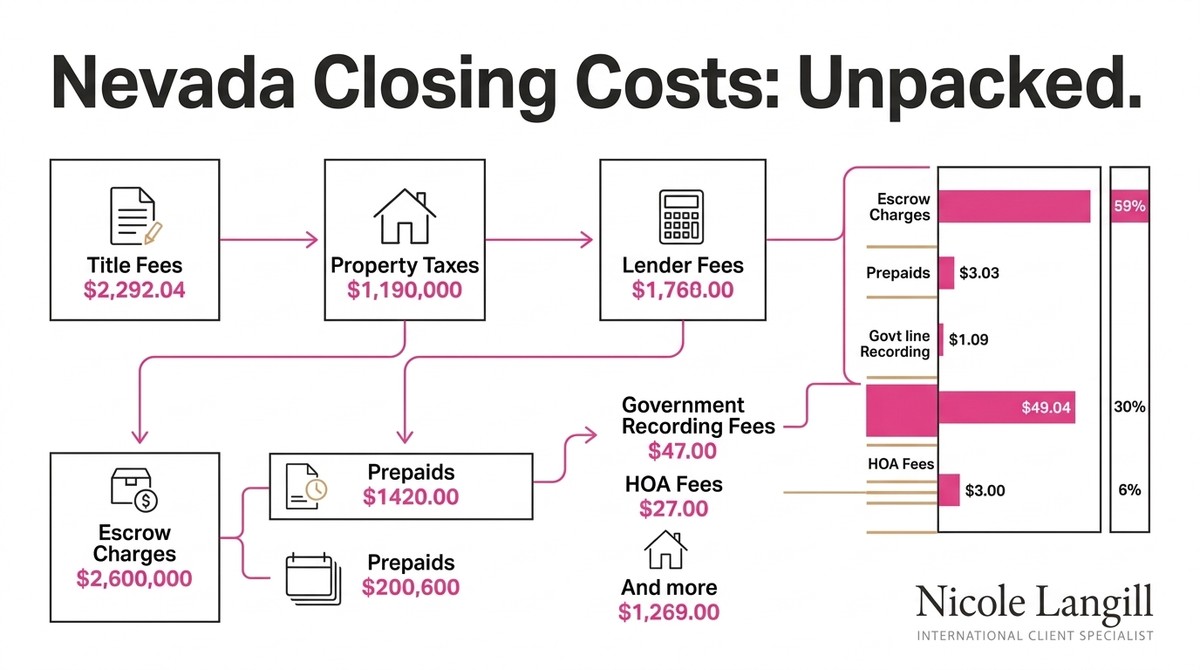
Navigating a property acquisition requires strict attention to the logistical and financial details of the transaction. Nevada buyer closing costs typically range from one to three percent of the total purchase price, depending on the property value and loan structure. Buyers need to separate these expenses into distinct categories to properly audit their final settlement statement. A precise understanding of these variables ensures a transition that protects your lifestyle and financial bottom line.
Discount Points and Interest Rate Buydowns
Buyers often choose to pay discount points upfront to secure a lower long-term interest rate on their mortgage. Each point typically costs one percent of the total loan amount and lowers the interest rate by a specific margin. This strategy requires careful mathematical analysis to determine the precise break-even point for the upfront investment. Deciding whether to buy down the rate depends heavily on how long you intend to retain the property as your primary residence.
Lender Origination and Underwriting Fees
Financing a property introduces specific costs charged directly by your chosen mortgage institution. Lender origination fees cover the administrative cost of processing your loan application and are often calculated as a percentage of the total loan amount. Underwriting fees compensate the lender for assessing your financial risk profile before approving the final mortgage. Reviewing these charges carefully allows you to compare different lenders when analyzing mortgage rate trends and finalizing your financing strategy.
Appraisal and Credit Report Charges
Lenders require objective verification of a property market value before committing capital to a transaction. An appraisal fee pays for a licensed professional to evaluate the home and confirm it justifies the agreed purchase price. Credit report fees are smaller charges that cover the cost of pulling your financial history from the major bureaus. Both of these are standard third-party expenses that buyers must absorb regardless of which financial institution they ultimately select.
Title and Escrow Charges Explained
The settlement process in Nevada relies on neutral third parties to manage the transfer of funds and property rights. Title companies perform extensive public record searches to ensure the seller has a clear legal right to transfer the home. Escrow officers coordinate the logistics of the closing, ensuring all contractual obligations are met before any money changes hands. These entities protect all parties involved, making their services a non-negotiable component of a secure real estate transaction.
Title Insurance Policies
Title insurance is divided into two distinct policies designed to protect different interests in the transaction. The lender title policy is mandatory if you are financing the purchase, as it secures the bank investment against future claims on the property. The owner title policy protects your personal equity, though in Southern Nevada, custom often dictates that the seller covers this specific premium. Clarifying who pays for each policy is a standard part of the initial purchase negotiation.
Escrow Settlement Fees
Escrow settlement fees compensate the closing company for acting as the secure clearinghouse for the transaction. In the Las Vegas market, it is standard practice for the buyer and seller to split the base escrow fee evenly. Additional minor charges may appear in this section, such as notary fees, wire transfer fees, and electronic document delivery charges. Monitoring these incremental costs helps maintain a precise accounting of your final cash to close requirement.
Government Recording Fees and Taxes
Local municipalities impose specific fees to legally document the change in property ownership. Recording fees are paid to the county clerk to officially register your deed and mortgage documents in the public record. Nevada also assesses a real property transfer tax, which is calculated based on the total sale price of the home. While sellers traditionally pay the transfer tax in Clark County, buyers should verify this arrangement in their contract when planning a full relocation to Southern Nevada.
Third-Party Property Inspections
Objective property inspections are critical investments that occur before you ever reach the settlement table. While you usually pay the home inspector directly at the time of service, lenders sometimes require specific specialized inspections that appear on the closing disclosure. Termite inspections, roof certifications, and structural engineering reports are common examples of secondary evaluations. Funding these reports protects your financial interests by ensuring you understand the true physical condition of the asset.
Prepaids and Escrow Account Funding
Prepaids represent future homeowner expenses that lenders require you to pay upfront at the closing table. These funds are collected to establish your initial escrow account, ensuring your ongoing property obligations are met automatically. Unlike standard closing fees, prepaids are not sunken costs; they are simply early payments toward your own property maintenance. Proper accounting for these line items prevents unexpected cash flow shortages during the first few months of ownership.
Property Taxes and Homeowners Insurance
Lenders demand proof of a fully paid twelve month homeowners insurance policy before they will authorize loan funding. You will also be required to deposit an additional two to three months of insurance premiums into your escrow reserve account. Property taxes follow a similar structure, with lenders collecting several months of tax payments upfront to buffer against future municipal tax bills. This mandatory capitalization ensures that the property remains fully insured and tax compliant throughout the life of the loan.
Mortgage Interest Per Diem
Another crucial prepaid expense is the daily mortgage interest that accrues between your closing date and the first of the following month. If you close near the beginning of the month, you will pay a larger sum of prepaid interest at the settlement table. Closing later in the month reduces this initial out of pocket expense, though it also accelerates the timeline for your first official mortgage payment. Strategically timing your closing date allows you to manage this initial cash flow requirement effectively.
HOA Transfer Fees and Capital Contributions
Purchasing a home within a managed community introduces specific association fees that must be settled at closing. Homeowners associations charge transfer and setup fees to update their internal registries with your contact and billing information. Many upscale communities also require a one time capital contribution, which is deposited into the community reserve fund for long term maintenance projects. Buyers purchasing your first high-end property must factor these association fees into their initial liquidity planning.
Negotiating Your Settlement Statement
A strategic approach to the purchase contract can significantly reduce your out of pocket closing expenses. Buyers can request seller concessions, where the current owner agrees to credit a specific dollar amount toward the buyer settlement costs. This tactic is particularly effective in shifting markets, allowing buyers to preserve their liquid capital for moving expenses or home improvements. Engaging in deliberate negotiation ensures your final contract reflects a highly competitive edge. For those planning future moves, similar financial strategies apply when reviewing insights on selling a local residence.
Auditing Your Disclosures
Reviewing the initial Loan Estimate is the first step in auditing your projected financial obligations. Lenders must provide this document within three days of your application, detailing the expected costs for origination, third party services, and prepaids. Before signing the final paperwork, you will receive a Closing Disclosure, which you must cross reference against your original estimates to identify any discrepancies. Holding your lender and escrow officer accountable to these figures is a fundamental aspect of sound financial management.
Frequently Asked Questions (FAQ)
Who typically pays for the owner title insurance policy in Nevada?
In the Las Vegas market, custom dictates that the seller usually pays for the owner title insurance policy. However, this is always subject to negotiation within the primary purchase contract. Buyers remain responsible for the lender title insurance policy if they are securing a mortgage.
Can closing costs be rolled into the mortgage loan?
Generally, buyers cannot roll standard closing costs into their mortgage principal on a conventional purchase loan. Some specific loan products allow financing of certain fees, but buyers should typically plan to pay these costs out of pocket. Negotiating seller credits is the most effective way to reduce this upfront cash requirement.
Are prepaids the same as closing costs?
Prepaids are technically separate from closing costs, as they represent ongoing homeowner expenses rather than transactional service fees. They include upfront property taxes, insurance premiums, and mortgage interest per diem. Lenders group them with closing costs to calculate your total cash required to close the transaction.
How much are typical buyer closing costs in Nevada?
Buyers should generally estimate their closing costs to be between one and three percent of the total purchase price. This percentage fluctuates based on the loan type, the lender fee structure, and the amount required for property tax reserves. A detailed Loan Estimate will provide the most accurate projection for your specific financial scenario.